
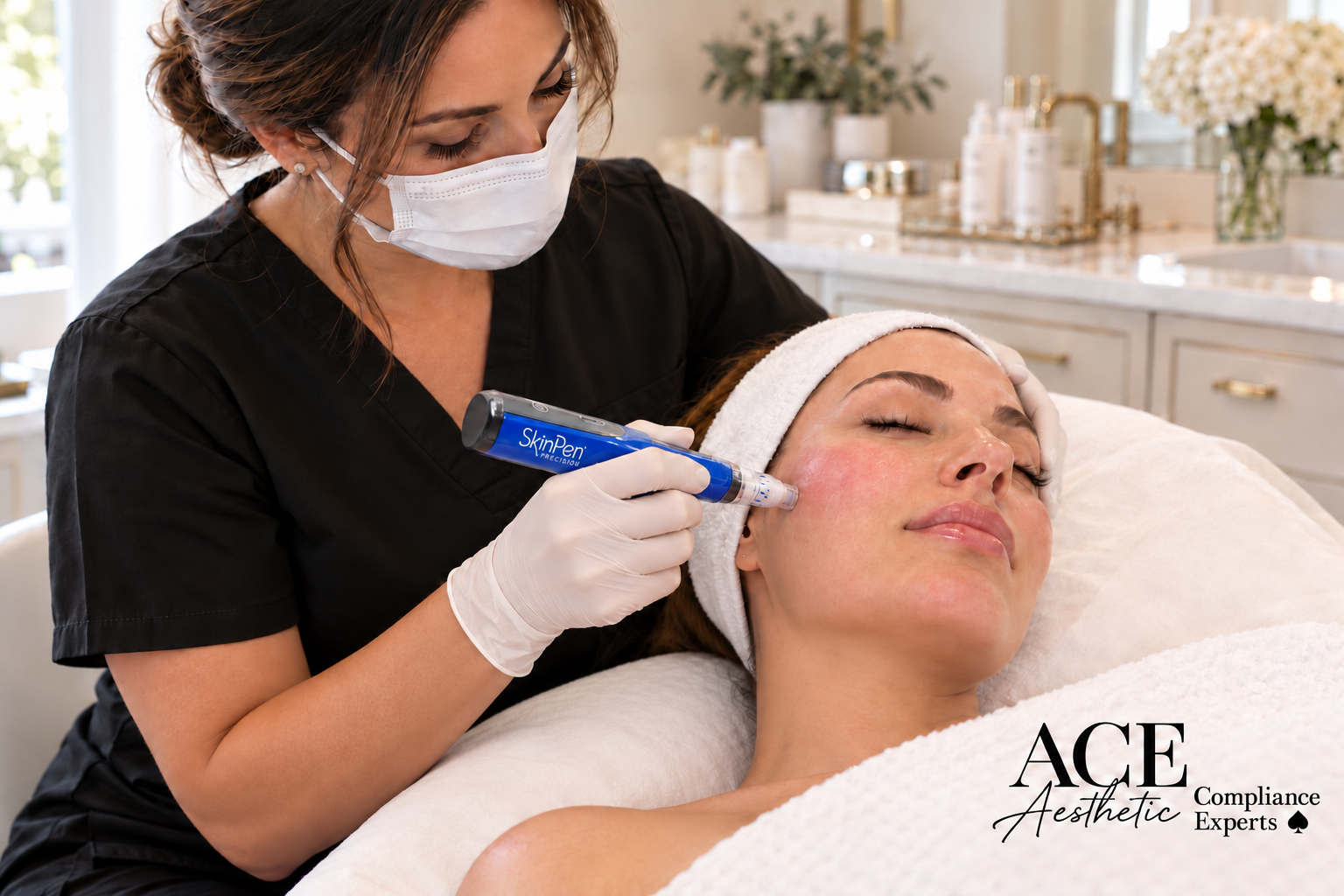
Indiana HB 1131 was signed into law and added microneedling to what an esthetician can do, starting July 1, 2026. If your Indiana clinic offers microneedling, the law also expects you to show proof of training if the state asks.
By Amber Bechthold, Founder & CEO of Aesthetic Compliance Experts · Esthetician with 25 years in medicine and aesthetics · Last reviewed October 28, 2026
Key Facts at a Glance
Status: Passed · in effect now
State: Indiana
Law: HB 1131 (House Enrolled Act 1131, Public Law 24, 2026)
Signed: February 24, 2026
In effect since: July 1, 2026, for the esthetician and microneedling parts
What it does: adds microneedling to the esthetician license, from 0.3 mm up to 2 mm deep
Who it affects: Indiana estheticians and the clinics that offer microneedling
What Changed
Microneedling is part of the esthetician license: Indiana added it to what an esthetician can do.
How the law describes it: fine needles making tiny punctures, from 0.3 millimeters up to 2 millimeters deep.
Proof of training: anyone offering microneedling has to show proof of advanced training or certification if the state asks.
Other services named: eyelash lifts and tinting, and eyebrow lamination and tinting.
Coming in 2027: electrology
New electrologist license: from July 1, 2027, it needs 600 hours of training and experience, and a cosmetology or esthetician license first.
Shared rooms: the state board has to allow electrology and esthetics to share a room, though not at the same time. That rule is due by June 30, 2027.
Why This Matters in a Med Spa
Many Indiana med spas offer microneedling through their esthetics team. The law ties it to the esthetician license and to proof of training, so your records need to show who does it, with what training, at what depth.
Does This Apply to My Clinic?
If your Indiana clinic offers microneedling, it's worth a look. This law applies only in Indiana.
What the law doesn't spell out
What microneedling training or certification counts as "advanced"
It does not mention lasers or injections
It does not define electrology
How the 2027 electrology rules affect electrologists already licensed
Ask the State Board of Cosmetology and Barber Examiners or your attorney.
Frequently Asked Questions
Can Indiana estheticians do microneedling?
Yes. Since July 1, 2026, HB 1131 includes microneedling in what an esthetician can do, from 0.3 mm up to 2 mm deep.
Do I need proof of microneedling training?
Yes. Anyone offering microneedling has to show proof of advanced training or certification if the state asks. The law doesn't say which training counts.
Does this law cover lasers or injections?
No. It doesn't mention lasers or injections.
Sources
Indiana General Assembly: House Enrolled Act 1131 (2026), final act text
Indiana Code 25-8-2-9.5, 25-8-2-14.7, 25-8-12.5-9, 25-8-10-3 and 25-8-10-3.1, as amended by Public Law 24
LegiScan: IN HB 1131 (2026) history. Legislative data via LegiScan (CC BY 4.0).
What This Means for Your Clinic
If your clinic is in Indiana, three records come first:
Who performs microneedling in your clinic, with their license type.
Each person's microneedling training certificate, kept where you can hand it over if the state asks.
The needle depths your devices and protocols use.
Then work through the rest:
Compare those depths to the range in the law, 0.3 mm to 2 mm.
Keep your device manuals with the depth settings you use.
Update your microneedling protocol and consent form so they describe what you actually do.
If you have an electrologist, file their license and training hours.
Watch for the board's shared-room rule before sharing a room between electrology and esthetics.
For how this law applies to your own clinic, ask your attorney or the State Board of Cosmetology and Barber Examiners.
Keep reading
Need a legal answer for your clinic?

ACE works with Doris Dike, Esq., founder of Dike Law Group PLLC, our outside legal counsel. If you need an attorney to look at how this applies to your clinic, her office can help.
Phone: (972) 290-1031
Office: 6160 Warren Parkway, Suite 100, Frisco, TX 75034
Book a call: dklawg.com/contact
Have questions about how this applies to your clinic? Book a free 30-minute Gap Analysis Call or text us anytime at (817) 442-7484.
This post is educational. It is not legal advice, and requirements differ by state and by practice. Confirm how any change applies to your clinic with your own attorney or your licensing board.
