
Medical Spa Compliance Program: The 8 Parts Every Clinic Needs
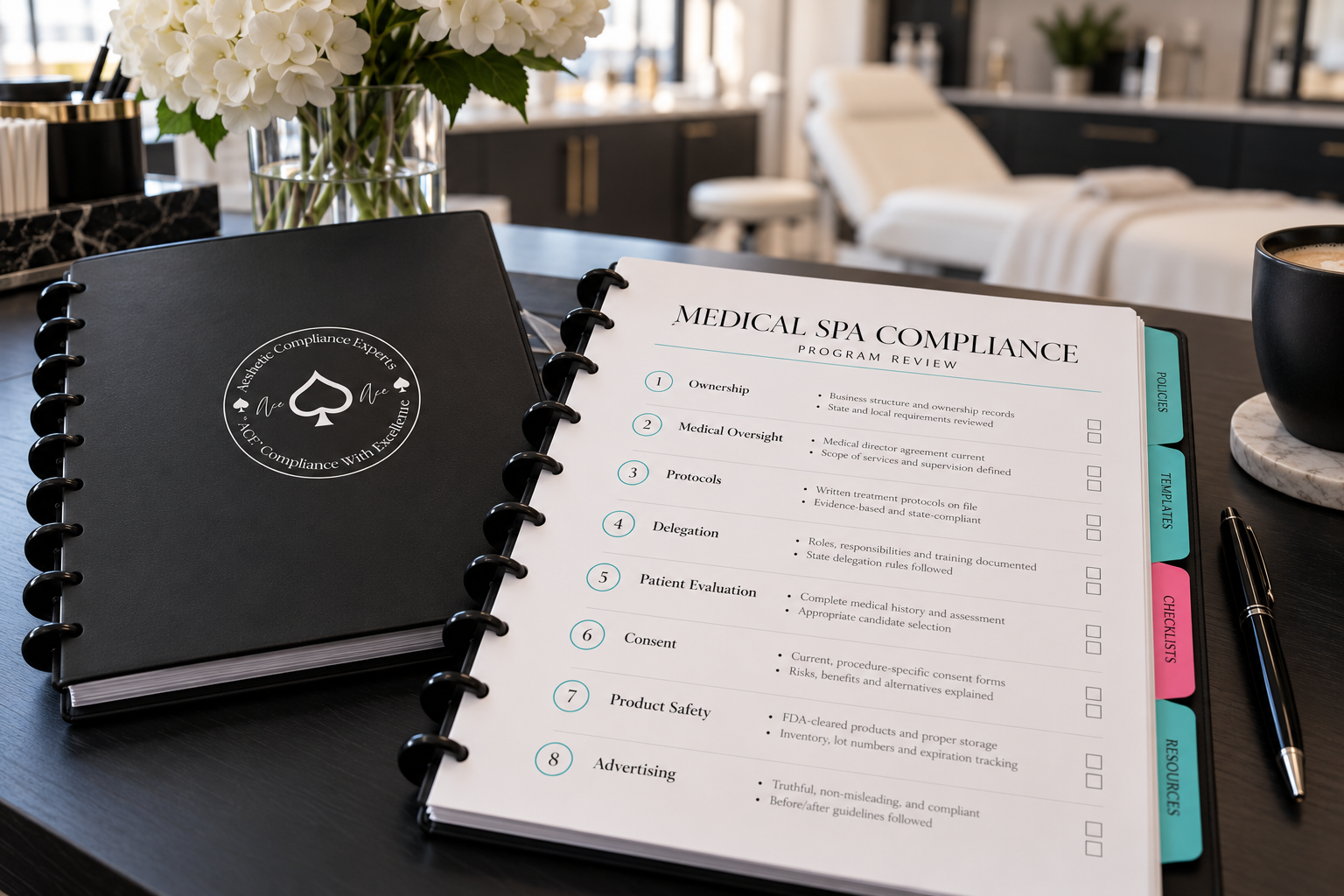
A medical spa compliance program is the set of written documents, roles and records that show your clinic runs every treatment the way your state requires. Most clinics have pieces of one, like a medical director, some consents and a protocol binder, but few have all of it current, signed and in one place. Here are the 8 parts a complete program covers, so you can check where it stands at your clinic.
By Amber, Founder & CEO of Aesthetic Compliance Experts · Esthetician with 25 years in medicine and aesthetics · Last reviewed October 24, 2026
What Is a Med Spa Compliance Program?
A med spa compliance program is not one document. It is everything that proves your clinic is set up and operating legally: who owns it, who supervises, who may do which treatments, how patients are examined and consented, how products are handled, and how you advertise.
When a licensing board, an investigator or an attorney asks "show me," your program is what you show them.
The 8 Parts of a Med Spa Compliance Program
1. Ownership and clinic structure
Many states limit who can own a business that provides medical treatments. This is often called the corporate practice of medicine rule. Whether a non-physician can own your med spa, and how the clinic must be set up if they do, depends entirely on your state.
2. Medical director and supervision
Medical treatments such as neurotoxins, fillers and many laser services need a licensed physician or other qualified provider overseeing them. Your program should show who your medical director is, what they are responsible for, and how supervision works when they are not on site. Supervision rules differ by state and by treatment.
3. Written protocols and standing orders
Every medical service on your menu should be covered by a written protocol signed by your medical director. Protocols describe how a treatment is performed, who may perform it, and what to do if something goes wrong. A new service usually means a new protocol before the first patient is booked.
4. Delegation and scope of practice
Your state decides which licensed professionals may perform which treatments, and under what level of supervision. Your program should show that every provider on your schedule is working within their scope, is named in the delegation paperwork your state uses, and has training on file.
5. Patient exam, consent and charting
Most states require a good faith exam by a qualified provider before certain treatments, a signed informed consent for that specific treatment, and a chart note for every visit. This is where busy days most often cause gaps.
6. Products, devices and records
Your program should track where your products come from, lot numbers, expiration dates and storage. In November 2025, the FDA sent 18 warning notices to websites selling unapproved, mislabeled botulinum toxin products, a reminder that sourcing records matter.
7. Workplace safety and patient privacy
Clinics that handle needles and blood are subject to OSHA's Bloodborne Pathogens Standard, 29 CFR 1910.1030. Clinics that bill insurance or send health information electronically may be HIPAA covered entities. Both belong in a complete program.
8. Advertising and promotions
Before-and-after photos, "results" claims, discounts and gift cards can raise questions under your state's medical advertising rules and federal truth-in-advertising law. Your program should include who reviews ads and posts before they go live.
Why Your State Changes Everything
There is no single national med spa law. Ownership, supervision, delegation, exam and advertising rules are set state by state, mostly by your medical, nursing and cosmetology boards, and they change often. A program built for Texas will not fit California, Ohio or New Jersey.
How Often Should Your Program Be Reviewed?
At least once a year, and any time something changes:
You add a new service or device
You hire a new provider or change your medical director
You open a new location, especially in another state
Your state passes a new law or board rule
What This Means for Your Clinic
Know what you already have. List which of the 8 parts above your clinic has in writing today, and which are current and signed.
Know your state's rules. Ownership, supervision and delegation depend on where you practice. Your licensing board and your attorney are the places to confirm them.
Know when your rules change. The ACE Edit tracks state law and board updates for med spas every month, in plain English.
Need a legal answer for your clinic?
ACE works with Doris Dike, Esq., founder of Dike Law Group PLLC, our outside legal counsel. If you need an attorney to look at how this applies to your clinic, her office can help.
Phone: (972) 290-1031
Office: 6160 Warren Parkway, Suite 100, Frisco, TX 75034
Book a call: dklawg.com/contact
Have questions about how this applies to your clinic? Book a free 30-minute Gap Analysis Call or text us anytime at (817) 442-7484.
About the author
Amber Bechthold is the founder and CEO of Aesthetic Compliance Experts. She is an esthetician with about 25 years in medicine and aesthetics, has worked in medical aesthetics since 2016, and is a member of the Health Care Compliance Association (HCCA).
This post is educational. It is not legal advice, and requirements differ by state and by practice. Confirm how any change applies to your clinic with your own attorney or your licensing board.
